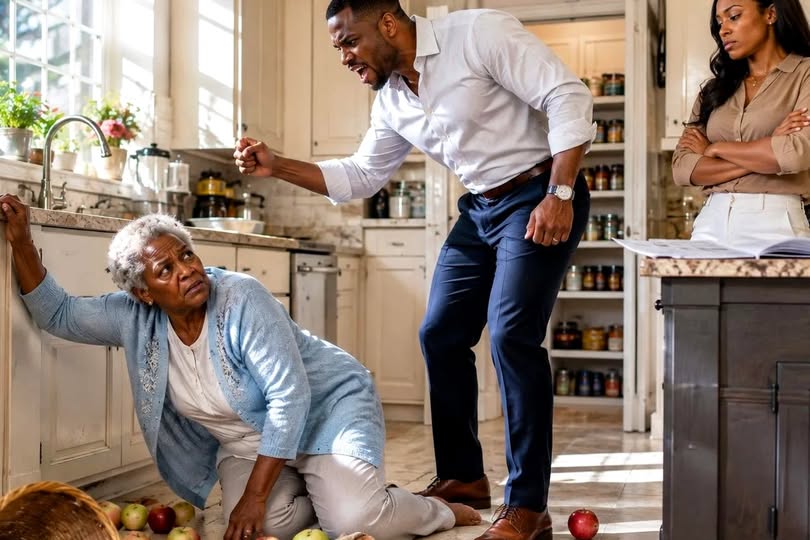
It was an ordinary morning that turned extraordinary in my kitchen, a place I had called home for over thirty years. The first sound that pierced the stillness was my daughter Rachel’s voice, sharp and accusatory, claiming I had stolen her entire future. The next was a violent shove from my eldest son, Mark, shoving me hard against the kitchen counter—unexpected, brutal, and disorienting enough to send me sprawling onto the cold tile floor.
All around me tumbled a bowl of apples I’d picked the day before, while Rachel stood nearby, arms crossed, trembling with fury and refusing to help me up.
“Three million dollars,” Rachel spat, her words slicing through the air like a knife. “You sold the farm for three million dollars, and you actually think you get to keep all of it for yourself?”
Cradling my side, where a sharp pain blossomed, I struggled to meet her gaze. Despite the disbelief twisting in my chest, I reminded her that her father and I had built that farm together over more than three decades. They had both chosen to walk away to build lives of their own.
“I’m your daughter!” Rachel shouted, her intensity rattling the dishes drying in the rack by the sink.
Mark stepped closer to me, a shadow falling over my kneeling form. “And I’m your son,” he said, his voice low but dripping with entitlement. “We deserve our share.”
What neither of my children understood in that moment was the codependent cycle we had woven. I’d quietly absorbed every mistake they’d made since their father’s death—clearing Mark’s college debt, covering Rachel when her boutique collapsed, and giving endless chances for them to build honest lives. Yet, through my generosity, I had only taught them how to expect more.
“The money is not available,” I asserted, struggling to maintain my composure.
“You mean you refuse to give it to us,” Rachel countered instantly.
Mark gripped my arm harder this time, forcing me down onto one knee while Rachel coolly demanded, “Now tell us where the money is.”
As I lifted my gaze to the small security camera mounted above the pantry door—installed years earlier after an unfortunate break-in—an unsettling realization washed over me. Neither of my children noticed where my eyes were drawn, or what that camera had already recorded of the scene playing out in my kitchen.
When I finally admitted selling the farm, I had braced myself for anger. But physical violence? Never. My heart sank as Mark produced a forged power of attorney document from his jacket, spreading it flat on the kitchen counter before me.
Less than twenty minutes later, as the front door creaked open, the atmosphere shifted. My attorney, Amelia, stepped inside, flanked by sheriff’s deputies. Their unreadable expressions held an authority that felt oddly both relieving and dreadful.
“Ma’am,” one deputy greeted me, his voice steady but gentle. “We’ve received a report regarding possible financial fraud involving your children. May we speak with you?”
I nodded, a lump forming in my throat as Rachel and Mark’s anger morphed into confusion and then pure panic. Their façade began to crumble.
“Sit at the table,” Amelia instructed, her calm demeanor grounding me against the rising storm. She helped me to my feet, allowing me to reclaim my dignity.
“What did you do?” Rachel asked, her desperation creeping in. “You called the cops? After everything we’ve done for you?”
“Let’s just explain what’s going on,” Amelia replied, her soothing presence cutting through the tension. “No one is here to escalate anything, but the documents you presented to your mother don’t hold up under scrutiny. »
As the deputies stepped forward and unveiled the forged document, a swell of relief washed over me. They demonstrated the inconsistencies, making it clear that Rachel and Mark had underestimated not only me but also their reckless decisions.
“I didn’t do this,” Rachel whimpered, tears pooling in her eyes. Her earlier defiance shattered, revealing a terrified child trapped by her own choices. Mark stood silent, trying to process their rapidly crumbling narrative.
“That doesn’t justify violence,” I interjected, feeling a mix of hurt and resolve rise within me. “Don’t you see what this anger has cost us? I loved you both—I devoted everything to make sure you had futures. This isn’t the answer.”
The deputy, empathy lurking in his gaze, nodded solemnly. “Ms. Lawson, we need to clarify the situation concerning the sale and your intentions. Your children may have acted on misguided beliefs, but physical violence brings consequences.”
Taking a deep breath, the weight of his words lingered heavily on my shoulders. I looked toward Rachel and Mark, still engulfed by their tumultuous emotions. “This is also a chance for you both to recognize the choices you’ve made—”
“Mom, please!” Mark pleaded, stepping closer, desperation coloring his voice. “We didn’t mean for it to go this far.”
A stark truth jolted through me: “It’s too late for excuses,” I said softly, feeling the harsh reality of our situation settle. “You’ve crossed a line.”
As the sheriff’s deputies documented the scene and Amelia inquired into the specifics of the case, our kitchen—a once warm haven—had transformed into a battlefield. The smell of homemade apple pie lingered, an ironic contrast to the bitterness that filled the air.
In that moment, overwhelmed by grief for what had been lost, I resolved to no longer be the pillar supporting a crumbling relationship predicated on endless expectations. The sale of the farm hadn’t stolen their futures; rather, it forced us to confront the truth of our fractured ties.
I inhaled deeply, fortified by newfound resolve. Whatever lay ahead, I would stand my ground. This was my fight, my story to tell. As much as I hoped for reconciliation, I recognized that the path forward would necessitate confronting the truth—both theirs and mine—amidst the echoes of love long frayed.